From collection to kit
You do not usually get the chance to travel the world and pick, directly from its prettiest cities, the most remarkable examples of each architectural style. That is what the architect Rosario Fossati did over some thirty years. As a hobbyist herself, she rendered miniature versions of the styles she admired and built up a personal collection at quarter-inch scale.
From that collection came the Archistyles line of architectural scale dollhouses, offered to other hobbyists as kits. The idea was simple: each model would represent a real architectural tradition, tied to a specific city, and invite the builder to work its characteristic details by hand.
La Posada: Spanish colonial style from Taxco
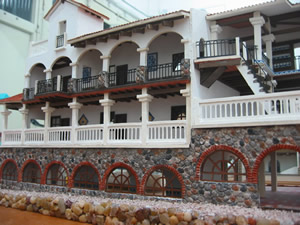
The first model of the line, "La Posada", is inspired by the Spanish colonial architecture of Taxco, in the Mexican state of Guerrero. Mexico holds some of the finest examples of Spanish colonial building in the Americas, and Taxco, a former silver-mining town of steep streets, white walls and red-tiled roofs, is one of the best known.
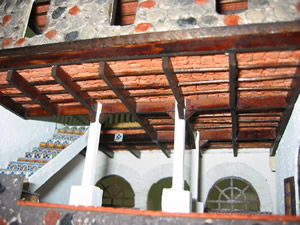
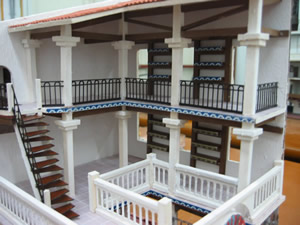
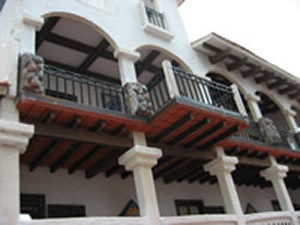
The model gathers the elements that define the style: brick and stone, rendered stucco walls, sloping roofs of red colonial tiles, heavy wrought-iron window grilles and a wide variety of decorative tiles. For a miniaturist, those tiles alone are an invitation: each one can be painted, printed or patterned, and no two finished houses need to look the same.
How the kit is made
La Posada comes as a kit of almost 700 laser pre-cut pieces in MDF (medium-density fibreboard). The walls, roofs, floors, beams and pillars are cut from 3 mm (about 1/8 inch) board, and the openings, balconies and finer details from 1 mm (about 1/24 inch) board. Manuals accompany the kit with step-by-step assembly instructions and suggestions on how to achieve the different finishes.
Laser cutting has changed the hobby. Pieces arrive with clean edges and exact joints, so the builder's time goes into finishing rather than measuring and sawing. The result is closer to an architectural model than to a traditional toy house.
Working at quarter-inch scale
Quarter-inch scale, 1:48, is half the size of the classic 1:12 dollhouse. The smaller scale makes it possible to model an entire building – with its patio, its street front and its roofscape – in the space of a bookshelf, but it also demands finer work. A window grille that would be a few centimetres long at 1:12 becomes a delicate piece of a centimetre or less.
Some practical habits help:
- Dry-fit every assembly before gluing, to check the order of the pieces.
- Seal MDF before painting, and paint small parts before they are glued in place.
- Use tweezers, a sharp hobby knife and a small square to keep corners true.
- Build textures in thin layers; at this scale, a heavy coat of paint hides detail.
- Work from photographs of the real style, not only from the instructions.
Styles planned for the line
The Archistyles line was conceived as a world tour of architecture. After the Spanish colonial model, it set out to cover three different Victorian styles – the brick Victorian of Boston, the wooden Victorian of San Francisco and the stucco Victorian of Montreal, in Canada – as well as the half-timbered Tudor architecture of Chester, in England, and the medieval Flemish architecture of Bruges, in Belgium.
Each of these styles poses its own challenges for the builder: the painted wooden trim of San Francisco's row houses, the exposed timber frames of Chester's buildings, the stepped gables and dark brick of Bruges. Together they would form a small street of the world's architecture, built by hand at the same scale.
A hobby that teaches architecture
Building an architectural scale dollhouse is a way of learning how a style works: why colonial houses in hot climates have thick walls and inner courtyards, why Tudor frames show their timber, why Victorian facades are so richly decorated. For travellers, it is also a way of bringing a city home. Taxco's colonial streets, for instance, are described in the Spanish-language guide to tourism in Mexico, and Argentina's own colonial towns of the Northwest appear in the English guide to Argentina's regions.